
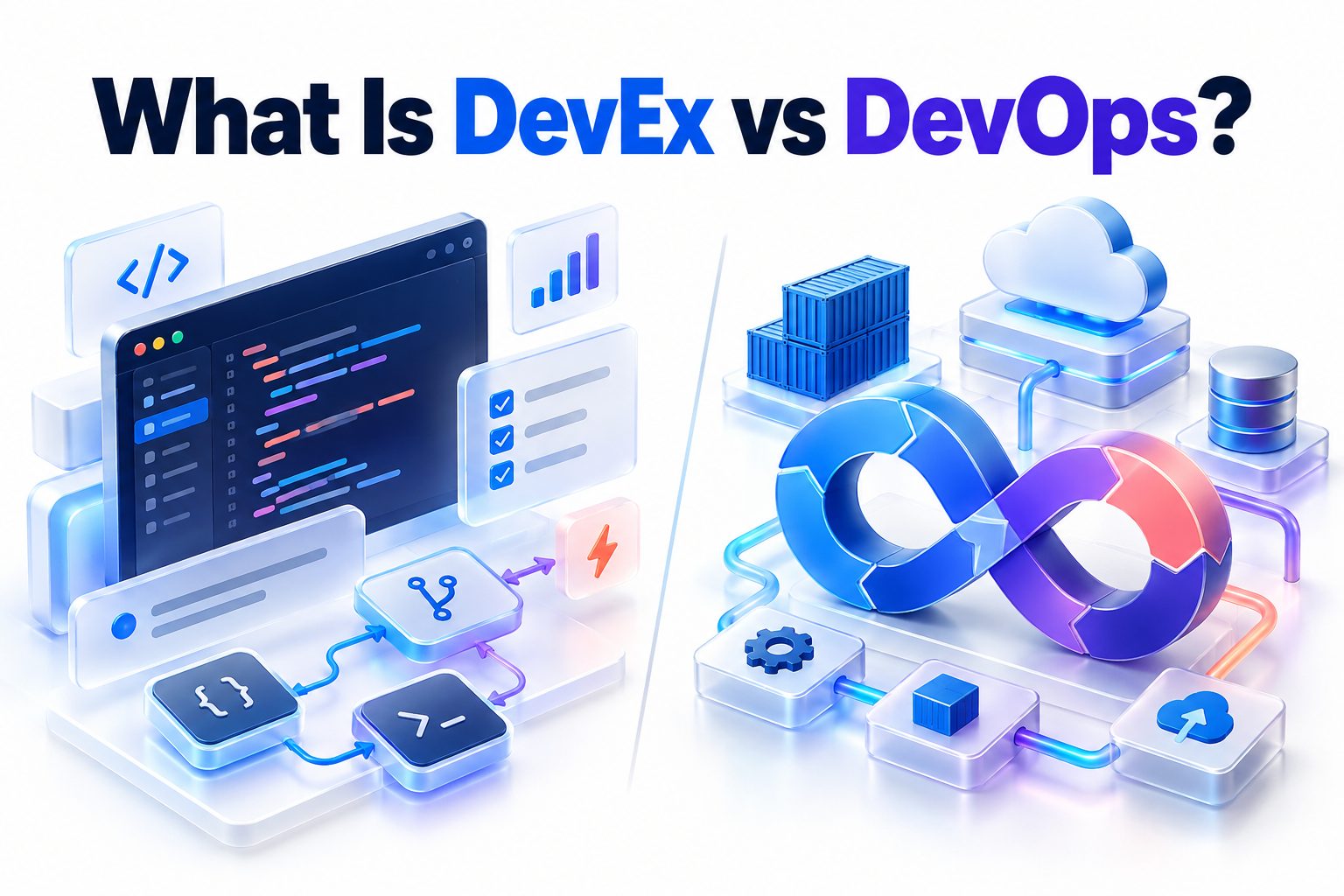
DevEx, short for developer experience, focuses on how easily and effectively developers can perform their work. DevOps is a set of practices and cultural principles that brings development and operations together to deliver software reliably and frequently. The two concepts overlap, but they solve different problems.
DevEx examines the daily developer experience: finding documentation, setting up a local environment, navigating a codebase, running tests, receiving feedback, and deploying changes. DevOps looks more broadly at the software delivery system, including collaboration, automation, continuous integration, infrastructure, observability, and operational ownership.
A company can have mature DevOps automation while developers still struggle with slow builds, confusing tools, or approval-heavy workflows. It can also provide excellent developer tools without having reliable production operations. Strong engineering organizations treat DevEx and DevOps as complementary disciplines rather than competing approaches.
This article explains where each discipline starts and ends, how they work together, which metrics reveal problems, and how teams can improve both without creating more process than value.
DevEx Explained
Developer experience describes the quality of a developer’s interactions with the tools, systems, processes, and people involved in software development. It includes both technical details, such as build speed, and organizational conditions, such as whether developers can obtain useful feedback or make decisions without unnecessary delays.
Good DevEx reduces the effort required to turn an idea into a safe, working change. Developers can locate accurate information, understand ownership, configure projects, test their work, and resolve failures without repeatedly asking specialists for help. The result is less friction, not simply more convenience.
The Core Dimensions of Developer Experience
Feedback loops are a central part of DevEx. A developer who waits 30 minutes for a test suite or several days for a code review loses context and works more cautiously. Fast, relevant feedback makes experimentation cheaper and helps defects surface while the change remains fresh in the developer’s mind.
Cognitive load matters just as much. Engineers must understand product requirements, code, dependencies, infrastructure, security rules, and deployment procedures. A well-designed developer environment hides incidental complexity while keeping important behavior visible. The goal is not to eliminate complexity, but to prevent every developer from managing all of it manually.
Flow state is another useful lens. Developers make better progress when they can concentrate without constant tool switching, unclear handoffs, or avoidable interruptions. A coherent workflow protects that concentration while still providing the controls needed for security, quality, and collaboration.
Common DevEx Responsibilities
DevEx work may belong to a platform engineering group, a developer productivity team, or contributors distributed across engineering. Typical responsibilities include improving onboarding, maintaining internal documentation, creating project templates, standardizing local development, and making build or test systems faster.
The discipline also covers internal APIs, software catalogs, command-line tools, development environments, and self-service infrastructure. Not every organization needs a dedicated DevEx team. Every organization does, however, create a developer experience through the choices it makes—even when nobody manages that experience intentionally.
DevOps Explained
DevOps combines development and operations practices to improve the speed, stability, and repeatability of software delivery. It challenges the traditional model in which developers write code, hand it to an operations team, and consider their work finished once the handoff occurs.
Under a DevOps model, teams share responsibility for software throughout its lifecycle. Automation supports building, testing, releasing, configuring, monitoring, and recovering applications. Collaboration and operational feedback help teams make delivery decisions based on real system behavior rather than assumptions made before release.
The Main Goals of DevOps
DevOps aims to make changes small, frequent, and low risk. Continuous integration catches integration problems early, while continuous delivery keeps software in a releasable state. Infrastructure as code makes environments repeatable, and observability gives teams evidence about application health after deployment.
Reliability remains essential. Faster delivery has little value if every release causes disruption. Effective DevOps practices balance throughput with stability by using automated checks, progressive delivery, monitoring, incident response, and recovery procedures. Teams learn from failures and improve the delivery system instead of relying solely on individual caution.
DevOps as Culture and Practice
DevOps is not a job title, toolchain, or CI/CD product, although organizations often use the term that way. Tools support DevOps, but installing a pipeline does not automatically create shared ownership. Developers and operations specialists still need aligned goals, clear communication, and authority to improve the system.
The cultural element also does not mean every developer must become an infrastructure expert. Specialists remain valuable. The difference is that responsibilities and knowledge are connected rather than separated by rigid handoffs. Platform teams can provide safe abstractions while application teams retain meaningful ownership of production outcomes.
Key Characteristics at a Glance
DevEx commonly includes:
- Clear, current documentation that developers can find quickly
- Fast local builds, tests, and development environments
- Straightforward onboarding and project setup
- Consistent tooling across teams and repositories
- Useful error messages and actionable pipeline feedback
- Self-service access to common engineering capabilities
- Workflows designed to limit cognitive load and interruptions
DevOps commonly includes:
- Continuous integration and continuous delivery
- Automated testing and release controls
- Infrastructure as code and repeatable environments
- Monitoring, logging, tracing, and alerting
- Shared responsibility for production services
- Incident response and learning-focused reviews
- Frequent, reliable, and reversible deployments
The Key Differences Between DevEx and DevOps
The clearest distinction is perspective. DevEx evaluates the software development system from the developer’s point of view. DevOps evaluates how development and operations cooperate to move changes into production and keep services healthy. Both examine delivery, but their primary users and boundaries differ.
DevEx asks whether developers can complete meaningful work without excessive friction. DevOps asks whether the organization can deliver and operate software safely at a sustainable pace. A slow test suite is therefore a DevEx problem because it interrupts development, and a DevOps problem when it delays or weakens delivery.
Scope and Primary Outcomes
DevEx covers the entire working environment surrounding developers, including tasks that may occur before code enters a delivery pipeline. Finding the right repository, obtaining credentials, understanding architectural rules, and getting a useful review all affect the experience even when they are not traditionally classified as operations work.
DevOps has a stronger lifecycle and production orientation. It connects code changes to builds, releases, infrastructure, runtime telemetry, and incident learning. Its desired outcomes commonly include shorter lead times, lower failure rates, faster recovery, and more dependable services.
Users and Stakeholders
The immediate users of DevEx improvements are software developers and others who contribute to technical delivery. Their direct experience matters, so qualitative research, developer surveys, interviews, and workflow observation are important. Metrics alone may show delay without revealing why the delay exists.
DevOps serves developers, operators, security specialists, customers, and the business. A reliable deployment process benefits engineers, but its value ultimately appears in safer releases and better service performance. DevOps decisions therefore consider both internal workflow quality and external operational results.
DevEx vs DevOps Comparison
Area | DevEx | DevOps
Primary focus | Developers’ ability to work effectively | Reliable software delivery and operation
Main perspective | Internal developer experience | End-to-end software lifecycle
Typical concerns | Onboarding, documentation, tooling, feedback, cognitive load | CI/CD, infrastructure, releases, observability, incidents
Primary users | Developers and technical contributors | Development, operations, security, and product teams
Common outcomes | Less friction, better flow, faster feedback | Higher deployment frequency, stability, and recovery speed
Typical methods | User research, workflow design, platforms, templates | Automation, shared ownership, telemetry, delivery practices
Representative question | Can developers complete this task easily | Can teams release and operate this change safely
Potential failure | Pleasant tools with weak production practices | Automated delivery with a frustrating developer workflow
Where DevEx and DevOps Overlap
DevEx and DevOps frequently affect the same workflow. A CI pipeline is part of a DevOps delivery system, but its speed, interface, error messages, and ease of use shape DevEx. Improving the pipeline can reduce deployment risk while also giving developers faster, clearer feedback.
Internal developer platforms create another overlap. A platform may provide service templates, approved infrastructure, deployment automation, observability defaults, and access controls. It supports DevOps outcomes by standardizing operations and improves DevEx by turning complex procedures into understandable, self-service workflows.
Automation That Serves People
Automation is valuable when it removes repetitive work, applies rules consistently, or shortens feedback loops. It becomes harmful when it hides failures, produces vague messages, or forces developers through inflexible workflows. The number of automated steps is not a meaningful measure of either DevEx or DevOps maturity.
Good automation gives developers enough information to diagnose problems and a clear path for handling exceptions. For example, an automated security check should identify the affected dependency, explain the risk, and suggest an approved response. A red pipeline with no useful context merely moves manual effort elsewhere.
Platform Engineering as a Connecting Discipline
Platform engineering applies product thinking to internal technical capabilities. A platform team treats developers as users, studies their recurring needs, and provides reusable paths for building and operating services. This makes platform engineering closely related to DevEx while supporting many practical DevOps capabilities.
A platform should provide a paved road, not an unchangeable track. Sensible defaults reduce decision fatigue for common projects, while documented escape paths accommodate unusual requirements. More platform concepts are covered in [Internal Link: Platform Engineering Best Practices] for teams deciding what to standardize.
A Practical Example of Both Disciplines
Consider a team creating a new API. In a fragmented environment, engineers may spend days locating a template, requesting cloud access, configuring a pipeline, and copying monitoring settings. The service eventually deploys, but the process depends on private knowledge and repeated coordination.
A combined DevEx and DevOps approach provides a documented service template with automated tests, infrastructure definitions, deployment workflows, dashboards, and ownership metadata. Developers receive a usable starting point, while operational requirements are included by default. The workflow becomes easier and the resulting service becomes more consistent.
The process might look like this:
1. A developer selects an approved API template from an internal catalog.
2. The platform creates the repository, build configuration, service ownership record, and development environment.
3. The developer runs the service locally using documented commands that match the supported workflow.
4. Each commit triggers fast checks, with failures linked to actionable explanations.
5. A pull request creates a temporary environment for review and integration testing.
6. The approved change progresses through a controlled deployment with health checks and rollback support.
7. Runtime dashboards, logs, traces, and alerts are available from the service catalog.
This example improves DevEx by reducing setup time and uncertainty. It advances DevOps by making testing, deployment, observability, and recovery repeatable. The same investment creates value from two perspectives without requiring two disconnected programs.
Measuring DevEx Effectively
Developer experience cannot be measured accurately with a single productivity score. Output metrics such as commits, pull requests, or lines of code are easy to count but poor indicators of value. They vary by role and can encourage developers to optimize visible activity rather than useful outcomes.
A better measurement program combines perception, workflow, and outcome data. Surveys reveal whether developers feel productive and supported. System data shows where they wait. Interviews and observation explain the underlying cause. Together, these sources produce a credible picture without turning measurement into individual surveillance.
Useful DevEx Signals
Developer satisfaction provides valuable information when questions refer to specific experiences. Asking whether documentation is easy to find is more actionable than asking whether engineering is “good.” Teams can also measure onboarding time, build duration, test reliability, review latency, and the time required to provision an environment.
Measure friction at the team or system level rather than ranking individuals. A developer who completes fewer tickets may be resolving complex incidents, mentoring colleagues, or reducing long-term risk. DevEx measurement should locate constraints in the environment, not assign simplistic productivity scores to people.
From Metrics to Improvements
Start with a specific workflow, such as creating a service or shipping a small change. Identify each stage, its waiting time, failure rate, and required handoffs. Then ask developers which stage consumes the most attention or produces the least predictable result.
Choose one improvement and define both an experience measure and an operational measure. Reducing build time might improve developer satisfaction while shortening change lead time. Comparing both prevents the organization from declaring success based only on a faster tool that developers still find unreliable.
Measuring DevOps Performance
DevOps measurement focuses on the flow and reliability of software delivery. Common indicators include deployment frequency, lead time for changes, change failure rate, and time to restore service. These measures reveal whether teams can deliver frequently without sacrificing production stability.
Operational signals also include availability, latency, error rates, incident volume, and alert quality. The right selection depends on the system and business context. A consumer application, internal reporting tool, and regulated payment service should not share identical targets simply because they use the same delivery platform.
Interpreting Delivery Metrics Carefully
Metrics need context. Low deployment frequency could indicate a slow pipeline, tightly coupled architecture, manual approvals, or a product that changes infrequently. A short recovery time might reflect excellent automation, but it could also hide repeated minor incidents that deserve deeper attention.
The purpose is to improve the system, not to reward teams for attractive dashboards. When metrics become performance targets without context, people naturally change reporting behavior or split work artificially. Teams should use trends to prompt investigation and pair quantitative results with operational reviews.
Linking DevOps and DevEx Data
The most useful analysis often connects the two disciplines. Long change lead time may originate in slow reviews, unstable tests, environment queues, or deployment approvals. Each cause affects the developer experience differently and requires a different intervention.
Teams building a measurement program can connect these signals with [Internal Link: Software Delivery Performance Metrics]. A shared view helps leaders avoid isolated initiatives, such as buying a new developer portal when the actual constraint is an unreliable integration environment.
A Balanced Measurement Checklist
Use this checklist before adopting a DevEx or DevOps metric:
- The metric represents a workflow or outcome the team can influence.
- Its purpose is improvement, not individual developer ranking.
- Qualitative evidence is available to explain quantitative trends.
- The measure cannot be improved easily while making the real outcome worse.
- Teams know how the data is collected and used.
- Experience measures are paired with delivery or reliability measures where relevant.
- Results can be segmented by workflow, service, or team without exposing individuals.
- The organization reviews unintended effects and retires unhelpful metrics.
Common Mistakes When Applying DevEx and DevOps
One common mistake is treating DevEx as a collection of perks. New laptops and polished portals can help, but they do not compensate for unreliable builds, unclear priorities, or week-long review delays. Developer experience is shaped by the complete work system, including policies and team interactions.
Another mistake is reducing DevOps to tool ownership. Creating a “DevOps team” that receives every deployment request may reproduce the same handoff model under a newer name. Central specialists can provide platforms and expertise, but application teams still need clear responsibilities and timely operational feedback.
Building Tools Before Researching Friction
Engineering organizations often build internal portals because the idea is visible and appealing. Yet a portal cannot fix every problem. If developers struggle because permissions require five approvals, placing the same request form in a polished interface changes presentation rather than flow.
Research should precede implementation. Observe representative tasks, interview developers from different teams, review support requests, and inspect workflow data. Fixing a few high-frequency obstacles usually creates more value than launching a broad platform with features based on assumptions.
Standardizing Without an Escape Path
Standardization can improve reliability and reduce cognitive load, but excessive standardization blocks valid use cases. A paved road should cover common needs and make the safe choice easy. It should not force every workload into the same architecture regardless of technical constraints.
Document exceptions and require extra review only where the risk justifies it. Teams are more likely to use standard paths when those paths are genuinely efficient. If bypassing the platform is consistently easier, the platform has a product problem rather than an adoption problem.
Mistaking Speed for Effectiveness
Faster is not always better. A five-minute pipeline that misses critical defects may create more work than a ten-minute pipeline with dependable checks. Likewise, rapid deployment is not a success when teams cannot observe impact or reverse a harmful release.
Optimize the whole feedback loop. The relevant question is how quickly a developer can receive trustworthy information and act on it. Reliability, clarity, and recovery options should accompany speed improvements rather than follow as separate projects.
Common Mistakes to Avoid
- Buying a developer platform before identifying specific workflow constraints
- Measuring individual developers through commits, tickets, or lines of code
- Automating a confusing process without simplifying it first
- Requiring every team to use one rigid toolchain
- Adding approval gates without reviewing whether they reduce measurable risk
- Creating dashboards that teams cannot translate into decisions
- Ignoring documentation ownership after an initial launch
- Treating developer complaints as resistance instead of product feedback
- Optimizing deployment frequency while neglecting service reliability
- Assuming DevEx belongs only to a dedicated productivity team
Improving DevEx and DevOps Together
Begin with a real value stream rather than an organization-wide transformation slogan. Select a recurring task, such as changing an API, creating a service, or responding to a production defect. Map the path from the initial request through development, release, observation, and follow-up.
This approach exposes both human friction and delivery risk. It may reveal duplicated data entry, slow tests, unclear ownership, environment contention, noisy alerts, or manual rollback procedures. Prioritization becomes easier when teams can see which obstacles create the greatest delay, frustration, or operational exposure.
A Practical Improvement Process
1. Select a high-frequency workflow with visible developer or delivery problems.
2. Interview the people who perform the work, including developers, operators, security specialists, and reviewers.
3. Record active work time, waiting time, handoffs, failures, interruptions, and recovery steps.
4. Identify the constraint with the largest effect on flow or reliability.
5. Design the smallest improvement capable of testing the underlying assumption.
6. Define an experience signal and an operational outcome before implementation.
7. Release the change to a limited group and gather direct feedback.
8. Refine the workflow, document ownership, and expand only after evidence shows improvement.
This cycle treats internal engineering systems as products. It also limits the risk of large programs that produce tools without changing daily work.
Priorities for Smaller Organizations
Smaller teams rarely need a dedicated DevEx function or elaborate internal platform. They gain more from a consistent repository structure, dependable CI, concise setup documentation, automated deployments, basic observability, and clear service ownership. These foundations prevent avoidable complexity as the organization grows.
The best early investment is often reducing dependence on one knowledgeable engineer. If a new team member can run, test, deploy, and diagnose a service using documented workflows, the organization has improved both developer experience and operational resilience.
Priorities for Larger Organizations
Larger companies face fragmented toolchains, duplicated platform work, inconsistent controls, and greater coordination costs. They may benefit from a dedicated platform or developer productivity group, provided that group has a clear product mandate and regular contact with its users.
Start with high-volume needs shared across teams, such as service creation, CI templates, environment provisioning, secrets management, and observability. Track adoption voluntarily where possible. Repeated workarounds are valuable evidence that the supported path does not yet meet developer needs.
Choosing the Right Focus for Your Organization
Choose a DevEx-led initiative when developers cannot find information, onboarding takes too long, local environments are unreliable, feedback is slow, or routine tasks require specialized help. These symptoms indicate that daily engineering work contains friction even if production systems remain reasonably stable.
Choose a DevOps-led initiative when releases are infrequent, environments drift, incidents repeat, deployments require manual coordination, or teams lack production visibility. These problems point to weaknesses in delivery and operations. In practice, a focused initiative in either area will often expose opportunities in the other.
Quick Decision Guide
Prioritize DevEx when:
- Developers report high cognitive load or frequent interruptions.
- Setup and onboarding depend on undocumented knowledge.
- Build, test, and review feedback arrives too slowly.
- Internal tools are inconsistent or hard to use.
- Routine tasks require tickets to specialist teams.
Prioritize DevOps when:
- Releases are risky, manual, or difficult to reverse.
- Development and production environments behave differently.
- Teams cannot connect deployments to service health.
- Incident response depends on a few individuals.
- Delivery speed improves while failure rates continue rising.
Work on both when:
- Pipeline delays harm developer flow and release frequency.
- Platform complexity causes workarounds and inconsistent operations.
- Developers lack access to useful production feedback.
- Manual controls frustrate teams without reducing demonstrated risk.
- Service creation is slow and produces unreliable operational defaults.
Conclusion
DevEx and DevOps are related disciplines with different starting points. DevEx focuses on the conditions developers encounter while performing their work, including tools, documentation, feedback loops, cognitive load, and organizational processes. DevOps focuses on the shared practices needed to build, release, operate, and recover software reliably.
The practical answer to what is DevEx vs DevOps? is that DevEx improves the experience of creating software, while DevOps improves the system used to deliver and operate it. Neither should be optimized in isolation. Fast local development loses value when releases remain dangerous, and sophisticated deployment automation falls short when developers cannot understand or use it efficiently.
Start with one real workflow, collect evidence from the people performing it, and connect experience data with delivery results. Remove the most consequential constraint, measure the outcome, and refine the solution before expanding it. This focused approach helps organizations create engineering environments that are productive for developers, dependable for operators, and capable of delivering customer value without unnecessary friction.
Frequently Asked Questions
Is DevEx part of DevOps?
DevEx can support DevOps, but it is not simply a subset. It covers developer-facing experiences beyond operations, including onboarding, documentation, local tooling, code navigation, reviews, and the cognitive effort required to complete routine engineering tasks.
Is platform engineering the same as DevEx?
No. Platform engineering builds and operates reusable internal capabilities, while DevEx describes the quality of developers’ overall work experience. A well-designed platform can improve DevEx, but management practices, documentation, reviews, and team culture also influence it.
Can a company have DevOps without good DevEx?
Yes. A company may automate deployments and operate reliable infrastructure while developers struggle with slow tests, confusing pipelines, or poor documentation. The DevOps system can function, but its friction may limit adoption, speed, and long-term sustainability.
Who owns developer experience?
Ownership is usually shared among engineering leaders, platform teams, developer productivity specialists, and individual product teams. A central group may coordinate improvements, but every team that creates tools, policies, documentation, or workflows affects the developer experience.
Which metrics measure DevEx and DevOps?
DevEx metrics include developer satisfaction, onboarding time, build duration, test reliability, and review latency. DevOps metrics include deployment frequency, change lead time, change failure rate, recovery time, and service reliability. Combining both types provides better context.